
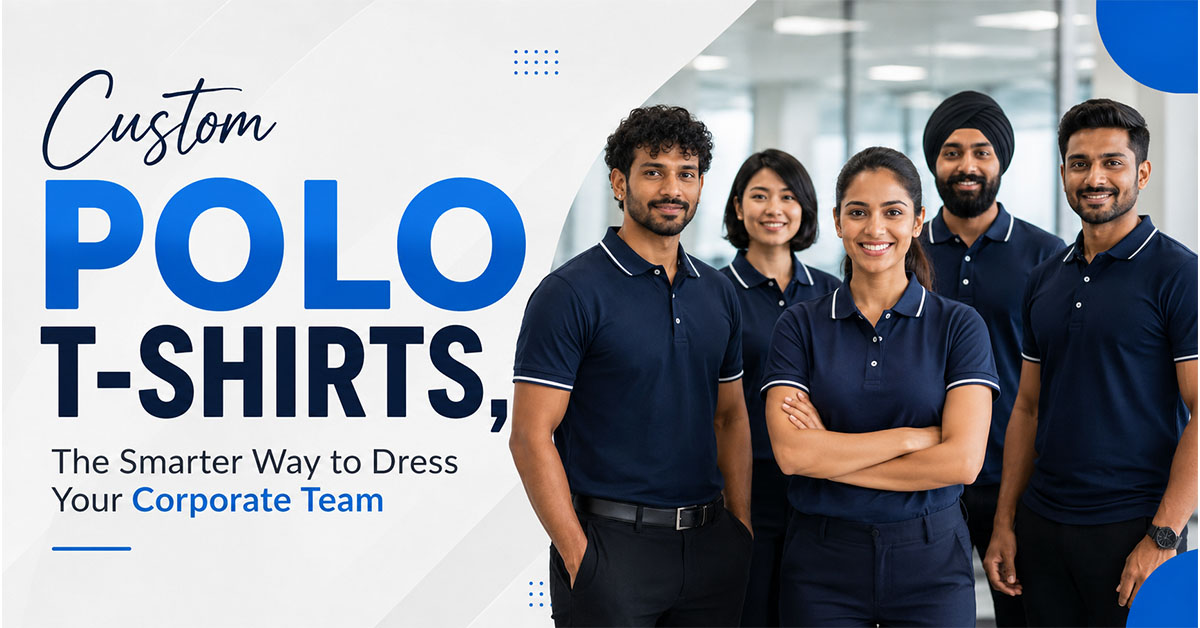
So your team’s uniform situation is a mess. Half the office is in random branded tees from that one event three years ago, the other half is wearing whatever they grabbed that morning. Sound familiar?
Here’s the fix most companies land on eventually: custom polo t shirts. Not because polos are trendy right now, but because they hit a sweet spot that plain tees and formal shirts just don’t. They look put-together without being stiff. They survive a full workday, a client meeting, and a quick lunch spill without falling apart. And once your logo’s embroidered or printed on, every person wearing one is basically a walking ad for your brand.
Why Polos Beat Everything Else for Work Uniforms
T-shirts are too casual for client-facing roles. Formal shirts are too much effort for daily wear, especially in Chennai’s heat. Polos sit right in the middle, and that’s exactly why HR teams and startup founders keep coming back to them.
A few reasons they work so well for teams:
- The collar automatically makes people look 20% more professional, no ironing required
- They’re breathable enough for field staff, sales teams, and anyone who’s not sitting in an AC office all day
- Cotton or cotton-blend polos handle repeated washing better than most branded merch
- You can mix and match colors by department without it looking chaotic
Honestly, once a company switches to polos for its team, going back to plain tees feels like a downgrade.
Getting the Fabric and Fit Right
This part trips people up more than you’d think. A polo that fits badly, or one made from fabric that pills after two washes, undoes all the benefits of having a uniform in the first place. People stop wearing it. Then you’re back to the mismatched-office problem.
Go for a cotton-poly blend if your team’s outdoors a lot; it dries faster and handles sweat better than pure cotton. If it’s mostly desk work, 100% cotton feels nicer against the skin for a full 9-hour shift. Fit-wise, slightly relaxed beats too-tight almost every time. Nobody wants to feel restricted in a meeting.
Where Printing Quality Actually Matters
This is the part people underestimate. A logo that cracks after three washes or fades to a weird grey isn’t saving you money, it’s just delaying the reprint order. Good t-shirt printing in Chennai uses techniques suited to the fabric and the design, not a one-size-fits-all approach slapped on everything that comes through the door.
For small, detailed logos, embroidery usually holds up longest. For bold, colorful designs across the back or chest, screen printing or DTF gives better coverage without the stiffness some older printing methods leave behind. A decent printer will actually tell you which method suits your design instead of just running whatever’s cheapest for them.
Scaling Across India, Not Just One City
If your company has offices in more than one state, the uniform headache multiplies fast. Different vendors, different fabric batches, different color matching, and suddenly the Bangalore office’s blue doesn’t match the Chennai office’s blue. It’s a small thing until a client notices in a group photo.
Working with a supplier that handles custom polo t shirts india wide solves this in one shot. Same fabric source, same color codes, same printing standards, shipped out to every location from a single order. It’s less coordination for whoever’s managing procurement, and it actually looks consistent when your team shows up to an event or a trade show.
For Teams Specifically Based in Anna Nagar
If you’re running a business out of Anna Nagar, there’s a decent case for going local instead of ordering from a supplier across town. Faster sample turnaround, easier to walk in and check fabric quality yourself, and honestly, less back-and-forth over email trying to describe a color that a photo never quite captures correctly.
Local t-shirt printing in Anna Nagar also means quicker reorders. If your team grows by ten people mid-year, you’re not waiting two weeks for a fresh batch to arrive from another city.
What Actually Matters When You’re Ordering
A few things worth checking before you commit to a vendor and a design:
- Ask for a physical sample, not just a mockup image. Screens lie about color more than you’d expect.
- Confirm minimum order quantities upfront. Some vendors quietly bump prices if you’re under a certain count.
- Get the logo placement approved in writing before the full batch runs. Fixing 200 shirts after the fact is a nightmare.
- Ask how they handle reorders for new hires. You don’t want to restart the whole design process every time someone joins.
None of this is complicated, but skipping it is exactly how companies end up with a warehouse full of polos nobody wants to wear.
Bottom Line
A good custom polo does more work than people give it credit for. It’s cheaper than most people assume, holds up better than random promotional merch, and makes your team look like an actual team instead of a group of people who happen to work at the same place. Get the fabric right, get the printing right, and pick a supplier who won’t ghost you when you need a reorder in a hurry. That’s really the whole game.